As I have been reading “On The Writing Well” and completing my internship at Girls’ Life Magazine, and completing my masters assignments, my perspective on writing has broadened significantly. I have always known that a written piece needs to flow with transitions and clear paragraphs, but I have learned the deeper layers of effective writing. I am aware of the power of a strong lead, the importance of keeping the audience’s attention at the end of each paragraph, and the value of eliminating unnecessary words and phrases.
I particularly noticed this growth when I was writing my blog for my visual storytelling class about how TikTok hacks your brain and its behavioral economics in design. After writing the first draft of the article and going back to it, I found myself asking questions: Are my first sentences of each paragraph encouraging my reader to keep reading? Does each paragraph invite curiosity? In the paragraph about scarcity, I opened up with: “When your time is limited doesn’t it make you more anxious?” I knew that asking this question would not only capture the reader’s attention but also make the reader think about their emotions.
Another change I noticed in myself in my writing whether it is for Girls’ Life or for my coursework is in my overall process. I now allow myself to write freely at first without trying to make it perfect. When I revisit my drafts I always find a bunch of clichés which I eliminate as they make my writing sound repetitive and unclear. Doing this helps my writing flow better. This revision process helps my writing flow more naturally. This is also important to do to keep your original voice in your writing. If you alter your writing too much just to fit your subject they might think you are talking down on them and will probably stop reading. The more confident you sound, the more your readers will enjoy reading your pieces.
Do you ever open TikTok for five minutes and suddenly realize it has been hours? That is not an accident. That is behavioral economics at work. The app does this on purpose through its behavioral design. In other words, the app studies your decision-making patterns and preferences so the algorithm can predict what type of content you would like to see on your “for you page.” Every like, comment, and repost becomes important data for them. When creating any type of app, especially on social media, it is important to use the easiest possible design layout to keep users engaged, which TikTok does very well.
Infinite Scroll Feature:
TikTok is unpredictable, which keeps its users scrolling for more. You never know what video will pop up next on your “for you” page. To keep you hooked, the app gets to know you like a friend. If you like makeup videos, the app will take notes and bring those type of videos to your page. If you like cooking videos, it will bring more of those. TikTok has that “slot machine” effect– the more content the app shows you that interests you, the longer you stay and the more money the app will make. To support this behavioral design, they make it as easy as possible to use the app so it becomes automatic to the user. This means users do not consciously think about their scrolling habits which keeps them engaged longer than they initially planned.
Social Proof:
Another behavioral economics principle TikTok uses is social proof. This is where users subconsciously make decisions based on what others are doing when they see a TikTok video. For example, if a user likes watching funny videos and sees the video has a lot of likes, they might stay on the video as it seems like it is popular and is worth watching. Maybe the user is interested in buying a new dress and they see one that catches their eye on their for you page. Most likely, they will save the video and come back to it later or make a purchase. Social proof makes a feedback loop that boosts engagement on a TikTok video. Since TikTok is full of short-form content, it is important to hook the user’s attention within the first few seconds. During those moments, users subconsciously decide if your video is worth their time.
Scarcity:
When your time is limited, doesn’t it make you more anxious? Well this is what TikTok exactly aims to do on their app. This is common on livestreams, where companies sell their products and put a countdown on them. This urges the user to jump on the sale as soon as possible as they do not want to miss out. This tactic is great for companies that use their app for business to create sales for their products. When these sales happen, users are never sure when they will see a good price on their product again so it encourages them to participate.
Creators can also experience scarcity when a sound, filter or challenge is trending. Jumping on trends is really important as they are constantly changing. A trend that is big one week might not be as big the next. Since these trends are what audiences find to be entertaining, it is important for creators to incorporate these trends in their videos so they can be sure to get the highest engagement rates possible.
While TikTok is designed to entertain you, you are now aware of the science behind the app. You now know why you are always scrolling for hours on end. Understanding these behavioral design strategies helps explain why apps like TikTok are the best at capturing attention and shows the power of psychology in social media. This is not just something TikTok does, it is what a lot of companies do in different ways to make sure they are staying in business.
Have you ever thought about how a product or experience can stir emotions and generate memories for people? Some companies care more about selling the value of customers’ experiences rather than just goods and services– and the experience economy is exactly that.
There are different stages of the experience economy (commodity, product, service, and experience). Commodities are the earliest stage focused on raw materials, goods are the next stage that turn commodities into real products, services are the goods delivered to the customer, and experiences are what create long-lasting memories for a guest or customer. When you apply this to a specific brand, what does this look like?
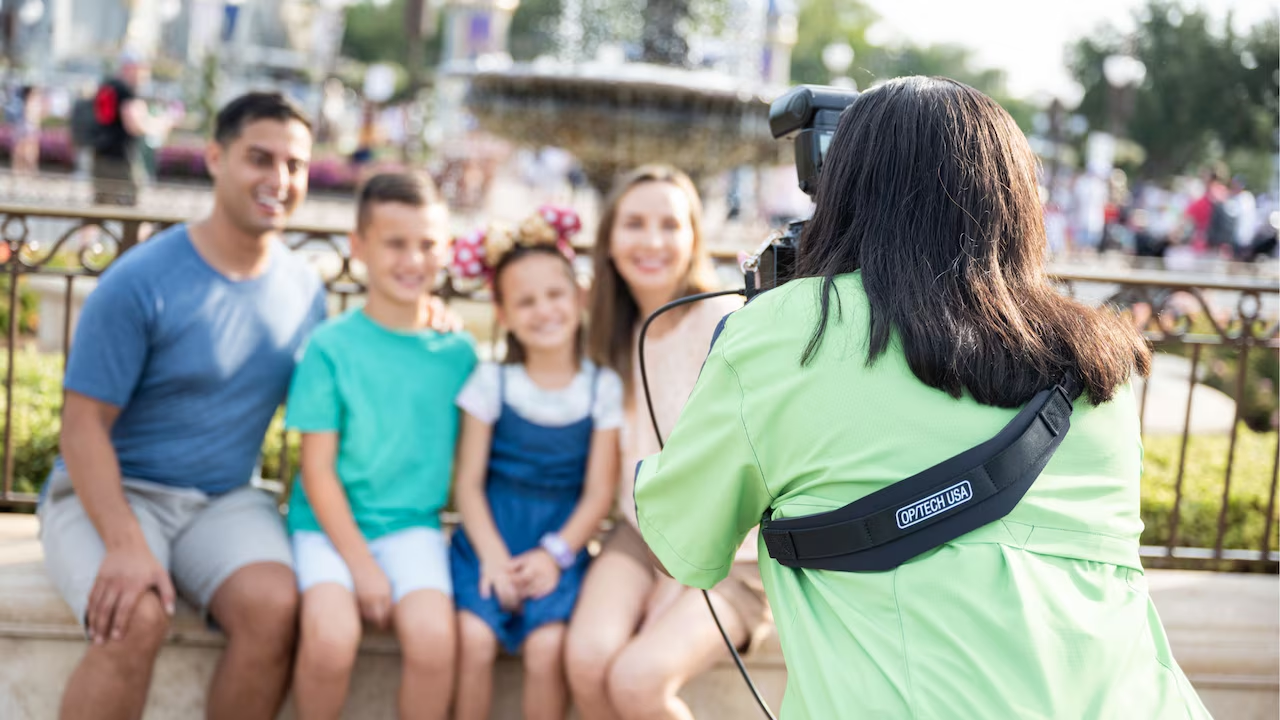
Take Disney World as an example. Their slogan is “the most magical place on earth” as this is what they aim to create for families when they are on vacation. What do they need in order to make this happen? For commodities they need the land it is built on, electricity to keep everything running, ingredients (whether it is for merchandise or food), and more. For products, they need souvenirs, merchandise (like Mickey ears or pins), food, etc. For service, they obviously need cast members who help everything run (like Photopass photographers who take pictures of families and guest relations to help guests solve their issues). For the experience stage, the most important part, it is all about transforming families’ park visits into unforgettable memories. This includes watching the Happily Ever After fireworks show at Magic Kingdom or going to the Bibbidi BobbIdi Boutique to make girls feel like a princess. Each experience is designed for their guests to feel like they are escaping the real world and being immersed in the magic.
Something that makes the experience so magical at Walt Disney World is the design of the architecture. Every building whether you are in one of the parks or a hotel makes you feel that escape from reality. One good example is Toy Story Land at Hollywood Studios. To make you feel like you are in Andy’s playroom, this whole part of the park is designed with what look like building blocks and everything around you is enlarged to make you feel that you have shrunk and that you are one of the toys.
Another important element of the design of the land is the colors. For Toy Story Land, Disney incorporates cheerful, bright colors like red, yellow, orange and blue to spark guests’ imagination as well as give them feelings of joy and nostalgia that comes along with the Toy Story movie. The color palette they use is not random– it is a part of Disney’s emotional storytelling.
In terms of how they make a map as an emotional journey map they also do this in Epcot’s France Pavilion. A lot of the architecture is made to look and make you feel like you are in France along with the smells it comes along with (the smell of crepes and French food at their restaurant). Also when you go the part of France where the Ratatouille ride is, the ride also makes you feel that you are a part of the movie as one of the rats. When waiting to get on to the ride, there are sounds and music from the movie to get your imagination flowing and immerse you into the world of Ratatouille. When you get on the ride, you get into one of the rodent carts (Remy or Emile) and you are then taken in the perspective as a rat trying to steal food from Gusteau’s kitchen.
When on “Remy’s Ratatouille Adventure,” you get positive and negative emotions. One minute of the ride you are running from chefs and fire to make you feel nervous and the next minute, you are smelling all the good food that Remy and his friends are eating in the kitchen. Stories without conflict are dull but by including these elements in the ride, this is what makes great storytelling as it takes you on an emotional journey.
While you might not realize it, all of these elements that are a part of the experience economy are what help create the memories you make wherever you go. Disney connects design with memory turning ordinary interactions into emotional connections. This is how design adds value and why it is so important.
When it comes to writing—whether it’s a blog post, an essay, or a magazine article—your introduction is everything. It’s your first impression, your chance to pull the reader in before they scroll away. A good opener can start with a question, a bold statement, or even a funny observation. The point is to make the reader curious enough to keep going. Every paragraph should build off the last one, creating momentum that makes your audience want to stay until the very end.
As an editorial and social media intern at Girls’ Life Magazine, I’ve learned how important it is to write with intention. Every week, I create articles that speak to girls ages 10–16, which means I’m constantly thinking about what will catch their attention and keep it. With so much competing for their focus online, short, to-the-point writing is key. But it’s not just about keeping things brief—it’s about connecting through voice. At Girls’ Life, our tone is friendly and real, like talking to your best friend. That sense of comfort and trust is what makes readers come back, and it’s something I always try to bring into my writing.
Another lesson I’ve learned is that good stories come from looking beyond the obvious. When I wrote about Meg Donnelly’s Broadway debut in Moulin Rouge!, I didn’t want to just list dates and ticket links. I wanted to tell fans something they didn’t already know—about her past performances, her connection to the show, and moments they could look forward to. Those extra details make readers feel like they’re getting an insider look, and that’s what keeps them hooked.
Whether you’re writing for a magazine, a blog, or even a school paper, the same rule applies: strong openings, authentic voice, and deeper research make your writing not only stand out—but stick.
Whether it is a blog, an essay, or a magazine– it comes to writing anything, it is important to have a strong introduction and include details that interest the reader in your topic. You could start it as a question, with humor or as a paradox, etc. As you are writing, the most important thing is to keep your reader hooked at the beginning and the end of the paragraph. Every paragraph should amplify the one that preceded it. It gives your reader a reason to stay. To make sure your writing is smooth,
As someone who is an editorial and social media intern at Girls’ Life Magazine, this was helpful for me to learn as I am someone who is writing different articles every week. As this is my first time writing for a magazine, I constantly have to put my self in the shoes of girls ages 10-16 in how they would approach reading this article. Since young kids nowadays, especially as they are growing up with technology, have short attention spans, I have realized it is important to keep my writing short and to the point. But when starting an article something I always have to ask myself is– what is the best way to pull them into the piece? Besides putting a question in the beginning, something I noticed that I think pulls the reader into your piece is your voice in the piece. The goal of Girls’ Life is to make young girls feel like we are their best friend. It gives them feel a sense of comfort in knowing we got their backs and that is what also has them coming back for more.
Another thing I realized is very important when it comes to writing for a magazine, especially when it comes to entertainment or news pieces is to look for material everywhere on a topic not just the obvious sources. For example, when I did my article on Meg Donnelly’s broadway debut in Moulin Rouge, I had to find more information about the show. Instead of just finding the obvious information of the dates she will be in the show and when tickets go on sale, I did deeper research on some of her past credits in acting as well as what the show is about and some moments in the show fans of hers will be excited about. When you include information that isn’t obvious it gets your audience excited to know about more information. I personally know when a show comes out, I want to know all of the details and this is exactly my point. When you include information others did not know about, it makes your piece stand out and keep your audience hooked.
When including these writing strategies in an essay or an article for a magazine, it will for sure making your piece more effective and draw the reader in for more.
As someone who works in entertainment marketing / social media strategy, I constantly have to think about how certain posts will perform now and in the future. This is where I have to use scenario planning and the cone of plausibility. After learning about these two concepts, I realized that these things can also be applied to social media strategies.
Scenario Planning In Social Media:
When it comes to scenario planning, as an editorial and social media intern for Girls’ Life Magazine and someone who runs my own young entertainment social media account (@emilieacktv), I constantly have to think about different scenarios of how my posts could perform.
For example, the video I made about Disney’s Zombies 5 being in the possible early stages of development, the likely scenario is that it will reach my current followers who are fans of the Zombies franchise. In a plausible case, the algorithm on Instagram and TikTok could expand my videos to other Disney Channel fans who have yet to have discover my page or in a wild case, it could be reposted or noticed by bigger creators or go viral.
Sometimes, a post might not do as well as I hoped so in this case I would think of how to improve my next entertainment news post. I reflect on what possibly could have caused these results — hashtags, timing, too much blabbering, etc. Through scenario planning, it helps me to anticipate multiple outcomes so I can respond quickly, adjust my strategy, and keep building momentum. This approach helps me create more engaging content for Girls’ Life Magazine and my own audience.
Zombies 5 is in the current stages of development? (Click to view!)
Cone of Plausibility in Social Media:
As for the cone of plausibility, it can help me determine how simple or bold I want to go with my visuals for the video. A likely approach would be me doing a simple news clip with basic visuals. A plausible approach would be me including some animated graphics or making fun comparisons to Disney movies. A wild approach could be a short cinematic teaser with fan theories, fun predictions, and or special effects.
Sometimes taking the wild approach in social media can be better as the algorithm favors unique and interesting content that will make the audience want to stick around for more. This where design of the future comes in. When I experiment with colors, movement, and layout, I am designing how my audience might experience entertainment content years from now.
Visual design plays a big role in how audiences interpret my videos. The better the graphics look, they are more likely they will be shared, which helps shape the future of entertainment storytelling online.
When it comes to writing for yourself and your audience, the most important thing to remember is to keep your writing style but also know who you are writing for. As publications like magazines and newspapers never want you to write in first person, this makes it more difficult to show your voice and personality in your writing. However, you should never overthink what the audience or editors want to see. Relax, be yourself, and come back and edit afterwards.
Learning all of this opened my eyes as I am a current editorial and social media intern for Girls’ Life Magazine. The mission of Girls’ Life Magazine is to inform, inspire, and entertain girls around the globe– whether that is entertainment, beauty, lifestyle and more. They want tween and teens readers to have someone who gets them. For many of the pieces I write for them, most of the articles are in second person to achieve this. For example, in one of my articles “How Pattern Mixing Can Instantly Upgrade Your Frosty Fits,” I write, “Don’t worry bestie we are here to help!” This kind of tone builds trust and loyalty so girls see Girls’ Life Magazine as a brand that speaks their language.
When it comes to writing articles for them and keeping my voice– I do notice that this is easier for me to do as many of the things I write about I am passionate about. However, I do notice that since I cannot put in my writing “I am so excited for this movie” I spin it into the language for Girls’ Life saying “we” instead. Second person makes readers feel included, understood, and a part of the community which is exactly what they want to do. I try to make my style sound friendly and confident, like the way I would talk to a friend. It also keeps readers engaged and prevents them from getting distracted.
This also applies to me when doing copywriting for social media. This has shown me that this does not just apply for writing articles but when connecting with readers in other mediums. Whether I am creating posts for Girls’ Life or my own entertainment social media, putting my posts in second person or using inclusive language help my posts feel like a conversation, keeping my audience engaged while still including my personality.
Something really important I have learned from all of this is that writing is not all about perfection. It is about getting down what you want to write without stressing so your voice comes through the piece naturally. Sometimes I am determined to get it right the first time, but I have learned what truly matters is getting down your thoughts first and then edit to have my authentic voice shine even if it isn’t in first person.
Check out one of my articles from Girls’ Life Magazine that illustrates this!
At Girls’ Life magazine, I write editorial pieces covering entertainment, beauty, style, and lifestyle topics. I also help manage the magazine’s social media presence for its 162K+ following, contributing to posts and digital strategies that strengthen engagement with readers. I collaborate with the editorial team to brainstorm new story ideas, stay up to date on pop culture and beauty trends, and ensure all content aligns with Girls’ Life’s creative voice and mission.
When it comes to writing articles or blogs there are certain things we need to pay attention to make sure our writing pieces are engaging. Some of these things include grammatical errors, telling the complete story, and the importance of the use of images.
Through reading articles and conducting peer reviews of classmates, something that stood out to me was how headlines and a lack of information can be misleading to the reader. When I peer reviewed Will’s self-introduction blog I realized the importance of storytelling when it comes to writing. Connecting your personal story to dreams you had as a kid to how you are applying those goals now is a great way to draw in your readers. This is definitely something I will incorporate into my own that I had not done with mine. In his blog, he specifically told a story of how he dreamed of working in video production in sports and how he is working to make this dream into a reality today.
Something else I noticed when conducting these peer reviews is how important it is to put yourself in the reader’s shoes to make sure they understand what you are talking about in the article. For example, if you write an article about an event but do not know the context behind it, then the reader will be lost and will most likely click away to a different article. Today, attention spans are short so it is also important to include a captivating introduction to make the reader want to continue reading.
These lessons are not only helpful for writing articles but for social media content as well. Even for short captions and visuals on social media, You always have to think about how you will draw the viewer in to interact with your content.
As someone who is currently interning at Girls’ Life Magazine as an Editorial and Social Media Intern, learning about these important elements of writing was incredibly helpful for me as I can apply them to the articles I write for the magazine. As an intern, I write articles on entertainment, lifestyle, beauty and more. For example if I am posting about a beauty trend, I would make sure the the graphic is colorful and eye-catching and then write a caption that encourages interaction like “Which look would you try this fall?” With this knowledge, I will now pay closer attention to the voice, headlines, and flow of my writing to make sure my pieces are engaging from start to finish.
A picture always has a thousand words. When looking at images or posters, each one tells its own story. Whether it is the color, the subjects in the image, or the background of the image, these are the elements that tell the meaning behind them. As someone who wants to work in entertainment marketing, I thought I would analyze the stills and posters of some of my favorite movies.
This Zombies 4: Dawn Of The Vampires movie poster does a great job of telling you what the movie is about. With this movie being the fourth one in the franchise, you can definitely see the themes of unity and embracing each other’s differences which is what the Zombies movies are all about. In the center, you have Addison, Zed, Eliza, and Willa who have been the main characters throughout all of the movies. Zed and Addison (in the center of the four) are holding the glowing bloodfruit, a key element symbolizing the energy and connection between the vampires and the daywalkers, the newest supernatural groups introduced in this installment. In the background, you see Nova (a daywalker) and Victor (a vampire), hinting at how the story could continue and how the main characters are taking what they learned throughout the four movies and passing them to the next generation. Visually, you see the orange side representing the daywalkers and the blue representing the vampires, showcasing division and unity. Even if you have not seen the movies before, the poster conveys these themes through its imagery and color design.
Zombies 4: Dawn Of The Vampires (2025) Movie Still
Another still I found from Zombies 4: Dawn Of The Vampires was another one I found very interesting and felt visually told the story very well. The main thing that helps convey the story in this still is the use of focus in the image. The characters focused in the image are Addison and Zed. You can tell from the photo that they are a couple and that they come from different supernatural universes by their appearance. Addison is an alien and Zed is a zombie. The focus on these two characters, contrasted with the blurred figures of Victor and Nova in the background symbolizes the closing of their chapter. They watch the new generation from afar with admiration, recognizing themselves in Victor and Nova’s story. In the first Zombies movie, Addison and Zed faced a social barrier as zombies were not accepted at their school. But now, they are mentors bringing the vampires and daywalkers together. This still beautifully and emotionally captures the passing of the next generation of the franchise.
Frozen (2013) Still
This still is from another one of my favorite movies, Frozen (2013). I felt that this still truly represented the main message of the movie really well. In this image, you can definitely feel the emotion. You can see how heartbroken Elsa is from accidentally freezing Anna’s heart as she embraces her frozen figure – showing love, protection, and sacrifice. I also felt like the snow in the background did a great job of symbolizing the tension in this scene as there are a lot of flurries flying around everywhere. Through Anna’s posture that she was frozen into (her holding her hand up to stop Hans from killing Elsa), you can truly see the close relationship her and her sister have as she tried to sacrifice herself when Hans tried to kill her. This scene is caused by the scene at the beginning of the movie when Anna and Elsa get into an argument when Anna keeps asking Elsa why she always shuts her out and does not understand why they could not be close like they were when they were kids. Elsa accidentally strikes her with her powers and runs off into the mountains. She later learns that the only thing that could save Anna from a frozen heart was an act of true love. She thought she had this with Hans, but that was not the case. He ended up tricking her because he only wanted to be crowned king of Arendelle and have the kingdom for himself. The main message of this still shows that an act of true love does not only come from significant others but from your family as well. In the end, Anna becomes unfrozen and she and Elsa live happily ever after.
Breaking Dawn Part 2 (2012) Still
From another one of my favorite movies, Breaking Dawn – Part 2, this still definitely captured the story clearly through its visual details. In the image, Bella and Edward stand protectively in the snow, with their daughter Renesmee slightly behind them and Jake in his wolf form by their side. Edward and Bella’s concerned expressions immediately convey tension, emphasizing their focus on protecting Renesmee. Having been conceived in Breaking Dawn – Part 1, Renesmee is growing rapidly, making her a target in the vampire world, where immortal children are forbidden because they can never mature. The Volturi are approaching to investigate and potentially punish the Cullens, raising the stakes even further. Family members in the background stand ready to defend them, highlighting the seriousness of the moment. Through posture, expressions, and the snowy setting, this still tells a compelling story of protection, loyalty, and the lengths a family will go to keep their loved ones safe.
The Hunger Games: Mocking Jay Part 1 (2014) Still:
In this still from The Hunger Games: Mocking Jay Part 1, I think there is a lot of symbolism here. With Katniss in the center, wearing her battle armor, and the poor people of District 8 holding up their fingers, it shows that she is the symbolism in hope of restoring peace to the people of Panem. The people surrounding her look dirty, tired, and sad. The people of District 8 all looking at her with hope shows how much they believe in Katniss. In the still, Katniss also has a concerned expression on her face as she only wants to help them and is determined to fight for their rights. In the Hunger Games, President Snow as he believed control was necessary for order which is how all of this started in the first place. In the series, Katniss volunteered as tribute in the 74th Hunger Games after her younger sister Prim was reaped to be in the games. In the end, she and Peeta, who was the male tribute alongside her, who she eventually fell in love with. With them almost sacrificing their lives when they were the last two tributes left in the arena, these people truly believe in her making a difference as no one in Panem has ever taken this stand ever before.
From a Disney Channel original movie How To Build A Better Boy (2014), you can tell that the main characters and nerds of the school, Gabby and Mae, are being victimized by Naveah (the girl in the red) based on the way they are positioned in the photo. Gabby and Mae are facing towards her and her minions and along with their other classmates in school. You know these girls are Naveah’s minions without knowing anything because they are posed right next to her in a line wearing angel wings on the back of their shirts. You can also tell her classmates are victimizing them as they are all facing Gabby and Mae– some of them having smirks on their faces. Before this scene happened, Mae thought that Jaden, her crush and Naveah’s ex-boyfriend, was going to ask her to the homecoming dance. After Naveah overhears her telling Gabby how she thinks he likes her, she is furious and that is what leads to this moment. As Naveah is focused on targeting Mae, you can tell that this will be the central reason to the actions that happen later in the movie– Mae and Gabby building a robot boyfriend.
In this still from Mean Girls (2004), you can tell what the movie is about. To the left, you see Cady Heron who is the new girl at school looking over at “the Plastics” (Regina, Gretchen, and Karen) along with her crush and Regina’s ex-boyfriend Aaron Samuels. Looking at the way “the Plastics” are standing together along with Aaron, really shows they are basically “the celebrities” of the school. The way their standing looks like the way celebrities in real life would be posing if the paparazzi snapped pictures of them. Looking at the expression Cady has on her face while looking at them, you can tell that she easily compares herself to them and feels inferior. Especially after she has been hanging around them a lot. Another detail I think is symbolic of how Cady feels around them is the trash can standing in front of her. Seconds after this still, she actually falls into the trash can. Cady originally got involved with “the Plastics” when her new friends and enemies of Regina George Janice Ian Damian Leigh ask her to help them get revenge on her. However, when Cady ends up having a crush on Aaron, this causes things to get messy with “the Plastics.”